Siem Reap, Cambodia
We deplaned on the tarmac. Again, it was hot. A recurring theme. Inside the terminal we went through several lines. First, to deliver our passports with extra photos. Then to pay a fee according to the posted schedule of countries, A to Z, with their particular amount. In another line, our visa was permanently installed in the passport. We came here to visit 800 year old temple ruins, generally referred to as Angkor Wat. The city, as you drive from the airport, appears ready for mega conventions. On both sides of the streets, hotels, large hotels, for more than a mile. Nothing else, just hotels.
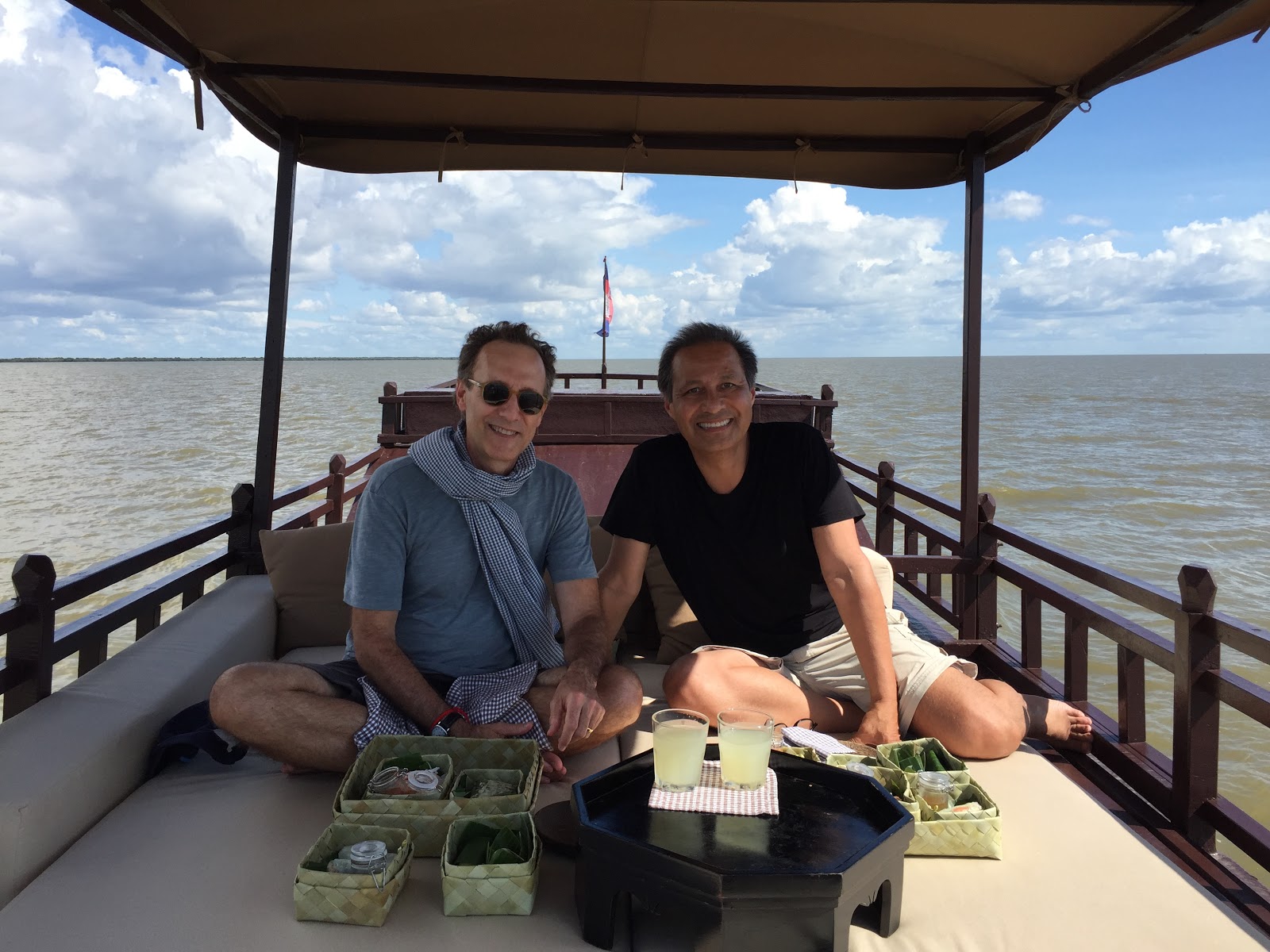
After ten minutes we pulled into the Amansara Hotel. Like the Four Seasons Chiang Mai, it is a destination in itself. I was reminded of British novels where one goes for a weekend in the country. To a castle. An estate. Downton Abbey. The host has your pleasure in mind. They send you out in vehicles appropriate to your activities. They make sure you are provided for. Occasional away meals are taken from baskets and served by a waiter. Our vehicles were a Jeep (American army, vintage 1960's), a luxury SUV with WiFi, a rustic wooden motor boat painted blue, a shallow row boat with a woman rower, a remorque (a form of tuk tuk) with a uniformed driver, a sizable boat with an awning covered roof deck and, finally, a 1962 Mercedes limousine, again with uniformed chauffeur. Our meals were a basket lunch atop the larger boat. And a breakfast on the deck of a traditional raised wooden cottage overlooking the royal lake of the Angkor Wat complex.
During our check-in we were assigned a person to take care of us. Our room was modern in a Mies van der Rohe way. One side, the shower included, had floor to ceiling glass facing the private pool. What a wonderful way to wake up. To dive into the water. It is instant. Each time we left the room, someone entered to work some form of magic. Flowers. Bowls of fruit. A bath with lotus flowers floating in the water. A gift; a scarf, a basket, a wooden fan. The lotus fiber scarf came with instructions to tie it around the neck like a tie, wear it like a diagonal sash (for giving alms to monks), wrap it as a turban. Many times we saw locals doing exactly that.
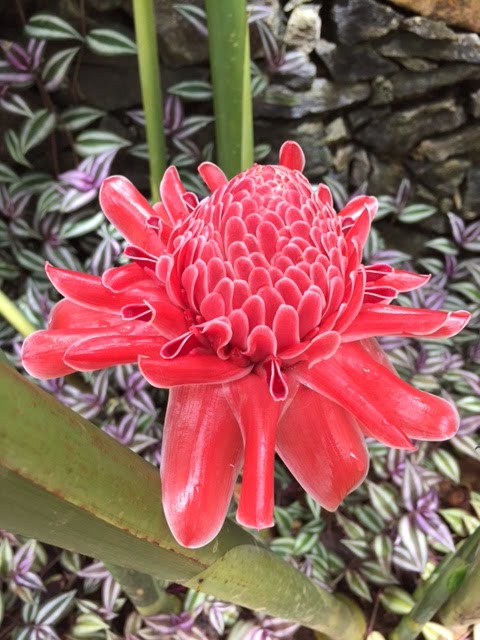
The dining room is round. Half of it is windowed out to a long rectangle lawn with a few tall trees. On both sides of the lawn, elegant open air corridors flow past the rooms. In front of each room are two chairs, a table and a large spray of orchids. The entire grounds smell of jasmine. It grows everywhere and where it doesn't they have sewn it into wreaths or threaded it onto long thin bamboo sticks. Outside during the day or in the dining room at night someone plays, solo, a traditional Cambodian instrument. The daily menus have traditional western food cooked by a chef from San Francisco. Also there is a Cambodian menu, which is mostly what we ate. I imagine it is tailored a bit to the western palate. But when it comes to hot and spicy chili effects, I was told the Cambodians typically add it at the moment of eating and not in the whole dish in the kitchen. The Food and Beverage director is Romain, a personable Frenchman. Everyday he inquired as to how our day was progressing or how he could be helpful. We came for visits to temple ruins, but the Amansara almost stole the show.

The optimal time for the ruins is before sunrise when it is cool and before the crowds become too dense. One of our excellent new friends, from the Azerai Hotel in Luang Prabang, suggested we request Yokohama as our guide. He is native Cambodian, specifically Khmer, an ancient, 1200 year old line. Long ago he owned a car by the name of Yokohama. It became his nickname. He showed us, at the outset, from his notebook the number of tourists to Cambodia, year by year. In 1986: 565. In 1995: 44,808. In 2005: 681,797. In 2015: 2,124,863. That explains the huge hotels. He has been a guide since the beginning, since there was one hotel. He has lived through the history we know through the movie, The Killing Fields. We asked him to tell us his stories. They were raw and emotional, as if they happened yesterday. He is well spoken in Cambodia's history and all it's current events. He speaks with pride and passion. His descriptions of what we were seeing were riveting and poetic.

Angkor was name of the capital city of the Khmer empire for six hundred years, beginning around 800. Each king built new temples. Some Hindu. Some Buddhist. It is the temple ruins that survived. Sacred buildings were made of stone. All other buildings, palaces and houses, made of wood are entirely gone, without a trace. Angkor Thom, was the base for King Jayavarman VII, a Buddhist king. There, his Bayon temple could be our favorite of the many ruins. It has towers. Each tower has four sides. Prominent on each side is a large smiling face with a full protruding lower lip and a stone lotus flower atop each tower. Yokohama, with glee and pleasure and pride stood in profile beside the smiling face to show his lower lip, identical to the stone faces. He repeatedly said, like a mantra prayer wish, the four faces, to him, are "love, sympathy, kindness and equanimity".

The temple grounds are enclosed within a stone wall. The entire square is oriented on a precise north, south, east, west axis. In the center of each wall is an entrance. From that doorway, looking forward, in a straight line, you look through a lined up sequence of a dozen doorways. Your eye is drawn all the way to the center where the Buddha statue would have sat or stood. With Yokohama, we crawled like ants up and down the walls and through the jungle. He was so intimate with the temples, it almost seemed possible he was present centuries ago.

A constant hazard for these dry stone constructions — where one stone is precisely fitted against another without mortar — is if a seed falls on top. When it becomes a slender root, it insinuates itself between the stones. As it thickens, it pushes the stones out of place. To further complicate the matter, the roots not only grow between, but also over the stones. The tree consumes the structure. The Ta Prohm temple, famous from movies — Tomb Raider — is an iconic example. The magnificent trees unquestionably rule. All the ruins, for centuries, were buried under trees and foliage. In the mid-1800's, a Frenchman found them. Then, as happened in Athens at the Acropolis, the saviors of the structures made off with the priceless sculptures. Every sculpture in every temple is headless.
On another day we saw Angkor Wat. We entered from the back at sunrise while nearly everyone else entered from the front. For half an hour we had to ourselves the long expanse of bas reliefs in which the Khmer, 800 years ago, depicted their civilization. The reliefs say — This is how we live. This is what we do. This is how we look. This is how we feel. In images crisp and clear. An elephant shaking a man in his trunk. A wheel with 8 spokes. Vishnu with eight arms. Chariots. A dragon with sharp teeth. Columns of people. Schools of fish. Archers with bows drawn. A tug of war with hundreds on each side. A leopard. Photographic detail. (We later learned, a recent Frenchman examined the reliefs for musical instruments then recreated the obsolete instruments and formed an ensemble to revive, as best could be done, the music). We walked from back to front where there was a circus of people. Another fine temple was the Banteay Srei, created to honor King Jayavarman VII's mother. Built of pink sandstone, with intricate carved images. We found ourselves inside a roped off area, inches from the fine and crisp detail. It's center room, in it's day, was jewel encrusted with rubies and sapphires.


We were told not to miss the Landmine Museum. We steeled ourselves for a blast of the worst of humanity. It did not disappoint. It boggles the mind to think humans could leave behind thousands of boobytraps to the peril of generations of absolutely innocent children and adults. The Museum is the creation of someone who has devoted his life to locating and disarming the mines. It is a seemingly impossible task with far too little support. Land mine promoters should be brought before The Hague for crimes against humanity. A mile down the road, we visited Madame Sophea Pheach, a Cambodia native, who escaped to Europe. She ached for her native land. She could have stayed away. She came back. Now, she raises silk worms and cares for her hundred or so employees and their families. She planted a forest of mulberry trees. The fresh leaves go to feed the infant moths. In one room she showed us their progression from eggs to adults to cocoons to reproduction. An entire life cycle. The cocoons are placed in boiling water. The single filament unwinds from the cocoon. It is rolled around a spool. Many stages later, she walked us through each one, she is left with golden silk yarn. The yarn is woven into fabric fit for a king. The designs are microscopically detailed. Her company is called Golden Silk. In her showroom, there is a display of those hand made musical instruments recreated from the temple bas reliefs.

It is always special to glimpse, without voyeurism, how people live. (They, too, given the chance, I think, would look to see how we live). Our time on the water was outstanding. We motored slowly, on the Tonle Sap Lake, past stilt houses. Functioning habitations. All in a row. Entirely standing above water. Houses, churches, schools. People were home doing their chores. Putting their shrimp out to dry. Repairing fishing nets. Bathing the kids. A dog climbed a ladder. Primitive boats were parked at shaky little docks. What is remarkable about this specific area is that the level of the water is seasonal. For half the year the level drops so much, people can walk on dry ground. The other half of the year is this, water everywhere.


Just beyond this village is a forest of mangroves. Like the houses, half the year they grow from dry ground. Now, they are submerged. We are paddling through them. I cannot seem to find the right spot in the shallow boat. (I never could sit cross legged). I could easily tip us over. That would be bad. Gliding through the mangroves is serene. The water is glassy. Peaceful. Still, I wonder about crocodiles. But I will my thoughts back to balancing the boat. From there we boarded the grand Amansara boat, with lunch, to motor across the vast lake. Just before docking we, we pass a Vietnamese village. It is the equivalent of a homeless encampment. Instead of tents, entire families exist on small boats. The children, as often do, play and laugh. It is their normal. On our way, driving from the dock, as we pass lotus fields, we stop at a open air covered structure on stilts. There, women are converting the lotus stems into fiber to be made into yarn. The kind of yarn our scarves, gifted from Amansara, are made from.


Meanwhile, back at the Amansara Hotel, we attended an hour of classical Cambodian dance. We sat on the rooftop under a bright moon. The dancers moved precisely like fragile marionettes. One of them, like Yokohama, had endured the trauma of the war years, the 1970's when the Khmer Rouge exterminated 25% of the population. Pol Pot, in sync with and supported by Mao, forced the country back to an era before there was education. To when farming was for the people and power was for him. To speak English, to exhibit evidence of trace of education meant punishment or worse.
From the roof, we walked downstairs for dinner. The grounds were candlelit. The air, as always, smelled of jasmine. Romain, the food director, told us the dining room was all booked up. He asked us to follow him for an alternate arrangement. We walked over the lawn with the trees, down the open corridor, past the large sprays of orchids. We arrived to the other side of a long Mies van der Rohe-esque stone wall. Parallel to it was a long slender body of water. Rows of candles led to a lone table, strewn with jasmine flowers, lit with candles, shaded by palms. A cross legged man played melodies on his one-string tro. Two glasses of French champagne were poured. It was a sweet and creative and generous and special and memorable birthday gift from the Amansara. It was the smooth and expert work of the fine manager, Astrid Killian and her F & B Manager, Romain Gayrard. Everyone benefits from their wisdom, experience and the coordinated efforts of their outstanding teams. A final gift, from Astrid's Turkish colleague, a pouch of Turkish coffee and a basket of Turkish delight, will stir Amansara memories once we are home.

From here we go to Naka Island, off the coast of Phuket, Thailand. There, there are no ruins, no museums. We will rest and reflect on the wonders of the world.
Wes and Marlow
Siem Reap, Cambodia
November 2017