Paris, 2009 (photo by Roland Kato)

Paris, 2009 (photo by Roland Kato)

Wednesday, October 16, 2019

Aquileia and Trieste: 21 May 2019

On the drive from Udine to Trieste we made two stops. The first stop was to see the urban planning oddity which is Palmanova. Built in 1593 as a Venetian city in the form of a nine-point star. The concentric streets radiate outward from the central piazza. Aside from the three entry points, what you see from outside is a tall hill; it snakes around the city. The idea was “a city as a fort.”  It did not catch on. Eventually, people were lures there by free lots.

The next stop was Aquileia, the home of mosaics from the year 313.

Also in 313, Emperor Constantine issued the Edict of Milan. The edict entitled people to freedom of religion. More significantly, it legalized christianity. In Aquileia, Bishop Theodore built a basilica. It was one of the first buildings created for christian worship. To make bible studies easier for those who could not read, the main stories were put into pictures. The main floor is about sixty-feet wide and 100-feet long. In appearance, it looks like a huge carpet. And it is divided into sections. Each section depicts a different theme.

Aquileia had already been a Roman city for five-hundred years. Underneath the basilica floor is a basement with the remains of those older houses and more, even older, 2200 year old, mosaics.

The city was mostly destroyed by Attila the Hun in 452. Though, the floors survived. The basilica was rebuilt and destroyed many times.  In 1031, Bishop Poppone, rebuilt what we, more or less, see today. He covered the mosaics with a floor of red and white marble pavers. They pavers remained until 1909 when the mosaics were rediscovered.

No one walks on the mosaics. There are no pews or furniture. An elevated glass walkway travels the perimeter of the room. There are also frescoes from 1100 and 1400, though they are difficult to focus on in contrast to the floors.


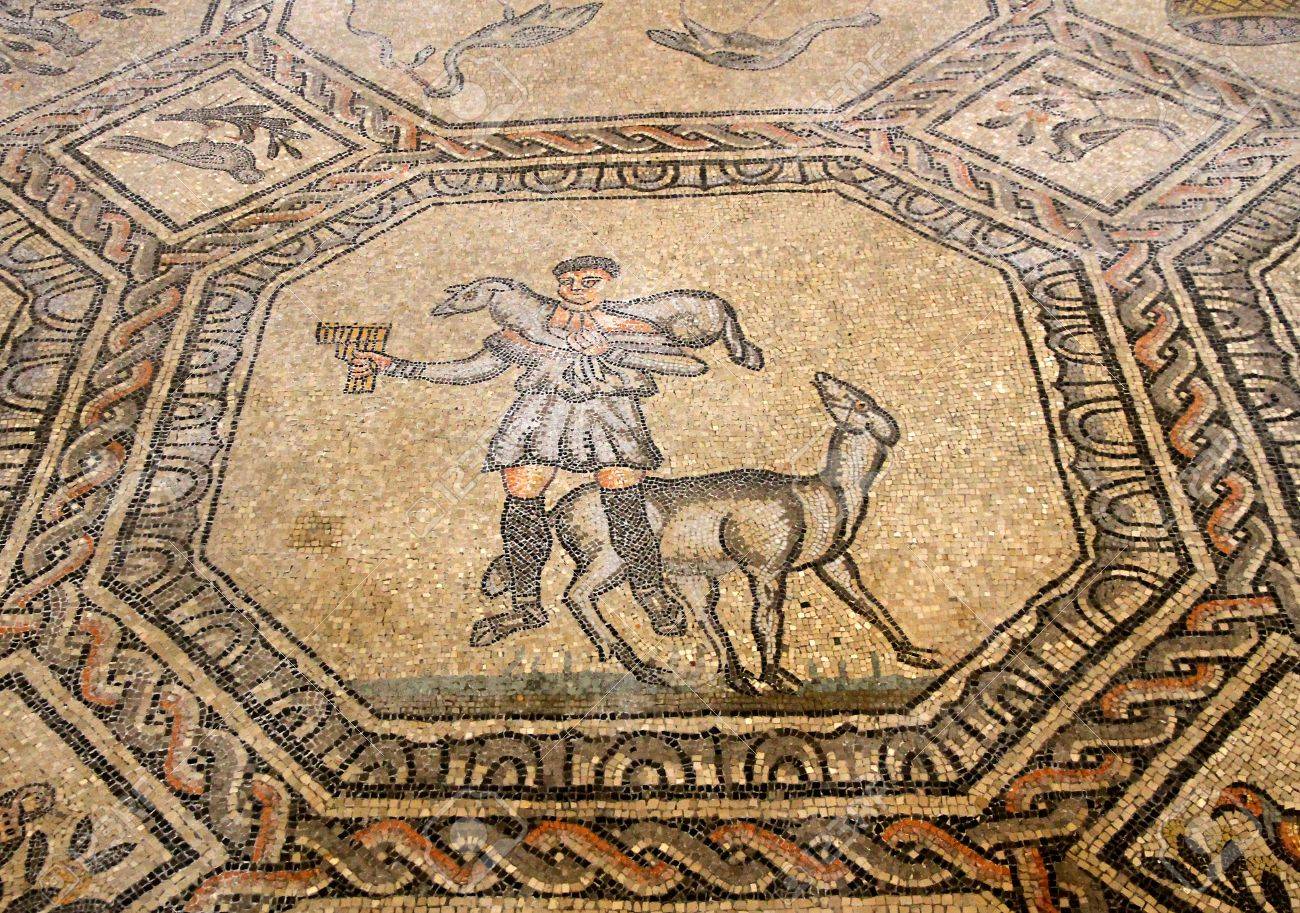
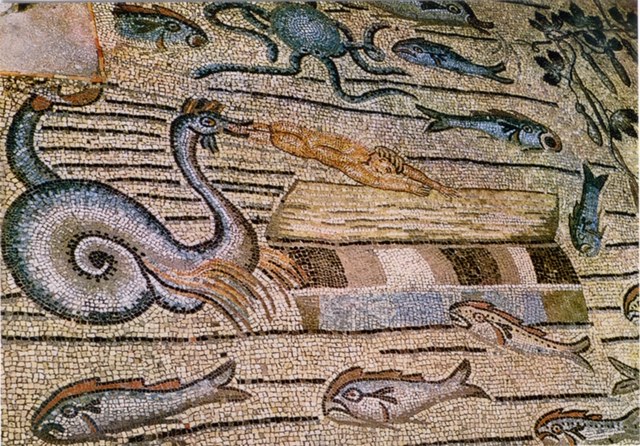
Two images made particular impressions on me. One is Jesus as a teenager with a baby lamb around his neck. By virtue of it being the oldest image, the one closest to the living person, does that make it definitive? The other image was a series of depictions of Jonah. But he is not tangling with a whale. It is a sea monster. A dragon like creature. He assaults it from a boat with a stick. Later, it spits him out. He is seen flying from it’s mouth like a cannonball. Finally, he is reclining under a tree. I am confused; who called it a “whale”? Is it a whale or a sea monster?


A few hours later, still pondering “whale? Sea monster?”, we arrived in Trieste. It feels like a big city. Right on the waterfront. Hills oriented toward the Adriatic Sea. The main square, Piazza Unità, has Imperial Austrian monumental scaled buildings on three sides, fronting on the sea. Our hotel, a former mansion, was on the main piazza. The hotel was furnished with attractive antiques. The floors were burnished parquet wood. Lots of brass. Comfortable wood framed chairs with velvet upholstery. Walls covered in floral fabric. The staff was attentive. The bar had great cocktails and local wines. Our room looked toward the piazza.

Reading the city’s history made my head spin. I cannot imagine living through the chaotic events of 20th Century Trieste.  Without getting into the complex history pre-1900; in 1914 Austrian Archduke Ferdinand and his wife, Sophie, were assassinated in Sarajevo.  Immediately, their bodies were sailed to Piazza Unità in Trieste. There were death rites and processions. The city was draped in black. Their coffins were sent by train to Vienna. Four years later, Europe exploded into World War One. So, until 1918 Trieste was part of the Austro-Hungarian Empire. From 1918 until 1943 it was Italy. In 1943, Nazi Germany occupied it. They built a crematorium. In April 1945, Yugoslavia moved in, but were swiftly ousted by U.S. and British forces, which stayed until 1954, when Trieste was ceded to Italy.


It was hard to relax into Trieste with that aswirl in my head. (I had similar difficulty in Dresden and Budapest and Berlin.) The only thing to do was eat and drink. Shift gears to dwell on what is present today and hopeful for tomorrow. We went to Caffè Tommaseo. It has been open since 1830. We ate jota. It was a cold and rainy night. We walked about with bright red hotel umbrellas.  The piazza buildings lit, were like wedding cakes. Jota is a local, cold weather soup; beans, potatoes, cabbage. We drank Malvasia and Schioppettino wine. We crunched on brutti ma buoni (ugly but good) cookies.


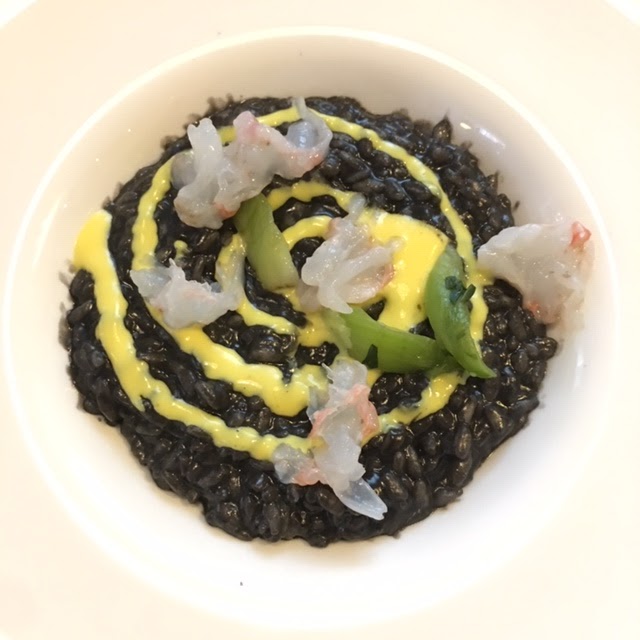
The next day, we went to Al Bagatto where we had four breads: sepia ink, traditional, soft brown with cardamom. There were five olive oils made from Puglia olives, Roman olives, and one from strong local olives. A small puff of fluffy Bacalao puree, with citrus gel and red currants. Our glasses were full of Pinot Grigio, but not ordinary PG. The local wine makers let the juice sit long with the grape skins. The juice takes on more flavor and an orange hue. The call the wines, “orange”, for the color. Our Pinot Grigio was this type, macerato. And we had Ribolla Gialla, another local, outstanding white. A caponata arrived; mild, easy on vinegar, no hint of capers or salty olives, not particularly sweet. Then fresh caught branzino marinated in ginger, raspberry vinegar served with trout roe,  slivers of asparagus. It was sweet uncooked fish, salty roe, sweet tiny sliced asparagus tips; flavor and texture zings and contrasts. The room sat 16. Everyone was Italian. We caught more and more of the conversations. Then risotto arrived. It had cuttle fish and shrimps. There was a pasta with swordfish. I asked the waitress, “how do I express these thoughts?” She taught me: Molto bello, molto bene, molto carino. The boss of Al Bagatto has every surface covered with important wines. He is friends with the local great growers and makers.

One featured wine maker, Edi Kante, we tried to visit. We drove to his country farm. We saw his chickens and ducks and peacocks and turkeys. But we did not see him. Perhaps, he was underground. The local hills are limestone. The serious makers have caves carved into the limestone hills. His caves are known to be particularly elaborate. In his caves he paints. For each new special wine he creates a contemporary painting for his pleasure and for the bottles’ labels.

Since we did not get to eat his food, we knew there was a rustic, local spot near by. We drove four minutes, parked the car and followed the laughter and merrymaking sounds. There was an open gate. There was a cluster of branches on it. Later, we learned that is the secret sign of an osmiza. Inside the wall were lots of tables. Some shaded by trees. Ours shaded by an awning. There was food and drink, but it was not a restaurant. An osmiza is a place which creates wine and cheese and cured meats. They are allowed to open to the public only a few days a year. We lucked out. The twigs on the gate is the sign. We asked for food. They gave us what they wanted to give. Platters of meats and cheeses and pickled vegetables and wines and crepes filled, one with strawberry and one with chocolate. We shared a picnic table with two Italians and a Czech. The weather turned wet. It rained. Then it poured. Our awning leaked, but the setting, the food, the drink, the company, the conversation in fractured english, french, italian made it a day to remember.


Wes and Marlow
Aquileia and Trieste
21 May 2019

Udine: 19 May 2019

We had a smooth transition from Vienna to Udine (Italy); several days ago. We rode a train. It’s route has UNESCO World Heritage status because it passes through villages which are a hold over from a century or two ago. There are no “cities” on the first half of the route. There are villages. Bucolic. Nestled, snuggled, into lush greenery of rolling hills. Alps, massive and snow covered, loom tall in the distance. Lovely, slow cows graze on more fresh greenery than they could possibly eat. Alpine cottages have carved wooden balconies with blooming red geraniums. Turquoise rivers come in and out of view from the train.

We are staying in the Astoria Hotel Italia. After Vienna’s Hotel Imperial suite, most rooms would seem plain. This room is plain, but entirely satisfying, quiet and comfortable.

We are in the historic center of Udine. The city of Udine is in the Italian region, (there are twenty,) of Friuli Venezia Giulia. For centuries, the cities of Friuli Venezia Giulia were pulled and tugged at by Venice and Austria. It did not settle into it’s Italian nationality until the end of World War II, when it chose to be in Italy.  (Though parts of it ended up in Slovenia.) Present day, the people speak, depending on the village: italian, slovene, german and friulian. 


In Udine, the Venetian influence is evident in the architecture. The city hall is striped by alternating layers of pink and white marble, reminiscent of the Doge’s Palace in Venice. On a tall pedestal, there is a statue of a winged Venetian lion. Beside it is an ancient statue of Hercules and a wonderful clock. The clock is topped with a large bell in between two huge, bronze, nude men. On the hour, the men bang on the bell with their long hammers.


We are enjoying Udine. We walk under ancient stone porticos from one piazza to another. Each piazza is teeming with local color. Children, accordionists, outdoor cafè life, pampered dogs, chiming church bells.

Our first food was a platter of San Daniele ham. The town of San Daniele is a dozen miles west. It is said, the cold alpine air from the north, as it meets the southern air from the Adriatic creates a special and perfect
climate for curing ham. The San Daniele ham, compared to garden variety prosciutto, seems more sweet and less salty.

Our platter arrived with three local cheeses and an assigned eating order. The mildest, young cow’s milk cheese first. The last was something “salata,” which is soaked in a salt brine. I did not get the cheese names. The busy waitress juggled serving the five tables in the small room. It was joyfully chaotic. The sound of spoken italian was like music. I mean no disrespect to spoken german, but it does not caress the ear, nor induce smiles.

This Italian region is famous for it’s white wines. By now, we have sampled many from a particular region, Collio. The grapes in Collio are typically Friulano, Ribolla Gialla, Malvasia Istriana, Chardonnay, Pinot bianco, Pinot grigio and Sauvignon blanc. Many of the wines are not blended, but made from the juice of a single type of grape. We have also had a red wine called Schioppettino, which, in the ones we have tried, have tasted young, light, fresh and of berries.

Here is a quick romp through visits to the surrounding towns.
Chapel of the patron saint of pork butchers in San Daniele.
14th C chapel. 16th C frescoes. 


Cividale de Friuli. Tiny. Seemed affluent. The buildings, residences and businesses, looked in excellent condition. The aquamarine Natisone river rushes through town. Ponte del Diavolo (bridge) crosses over it: constructed in 1442. A chapel, also, overlooks the river. The Tempietto Longobardo chapel was built around the year 750 and still has several of it’s original statues. It’s frescoes are relatively young, just 600 years old. At the start of the bridge is an excellent pastry shop where we had our first taste of gubana. Gubana are like a brioche stuffed with a paste of almonds, raisins, cocoa and cinnamon. It was love at first bite.
Natisone river


The small city of Cormons was part of the Austrian Hapsburg Empire from 1497 to 1918. Today, they still toast, on his birthday, the last Emperor Franz Joseph. Just outside Cormons, we had lunch in what felt like a forest. Under the canopy of mature trees, surrounded by wild shrubs, on tables crafted of rustic cut logs we had lunch at La Subida. We drank the white Ribolla Gialla and the fresh red Shioppettino wines. We ate a salad of paper thin sliced white and green asparagus. They served, yet another variety of cured ham, Oswaldo, which was even sweeter than San Daniele. As if the pigs ate cherries or berries with their acorns. There was also duck breast with perfumey strawberries. And risotto with herbs. And sautéed spinach. And sweet peas.

Dear Venzone is a phoenix risen from the ashes. It is an ancient and tiny walled city. In 1976 it was hit, two months apart, by massive earthquakes. The first one severely damaged it. The second one flattened the town and killed hundreds of people. By 1990, the city was restored. Even the cathedral, 80% destroyed, was reconstructed as close to what it had been. It was an absolute labor of love. I cannot describe the special ambiance of standing in their treasured church, which they loved too much to just cart away the rubble, but had to restore it.

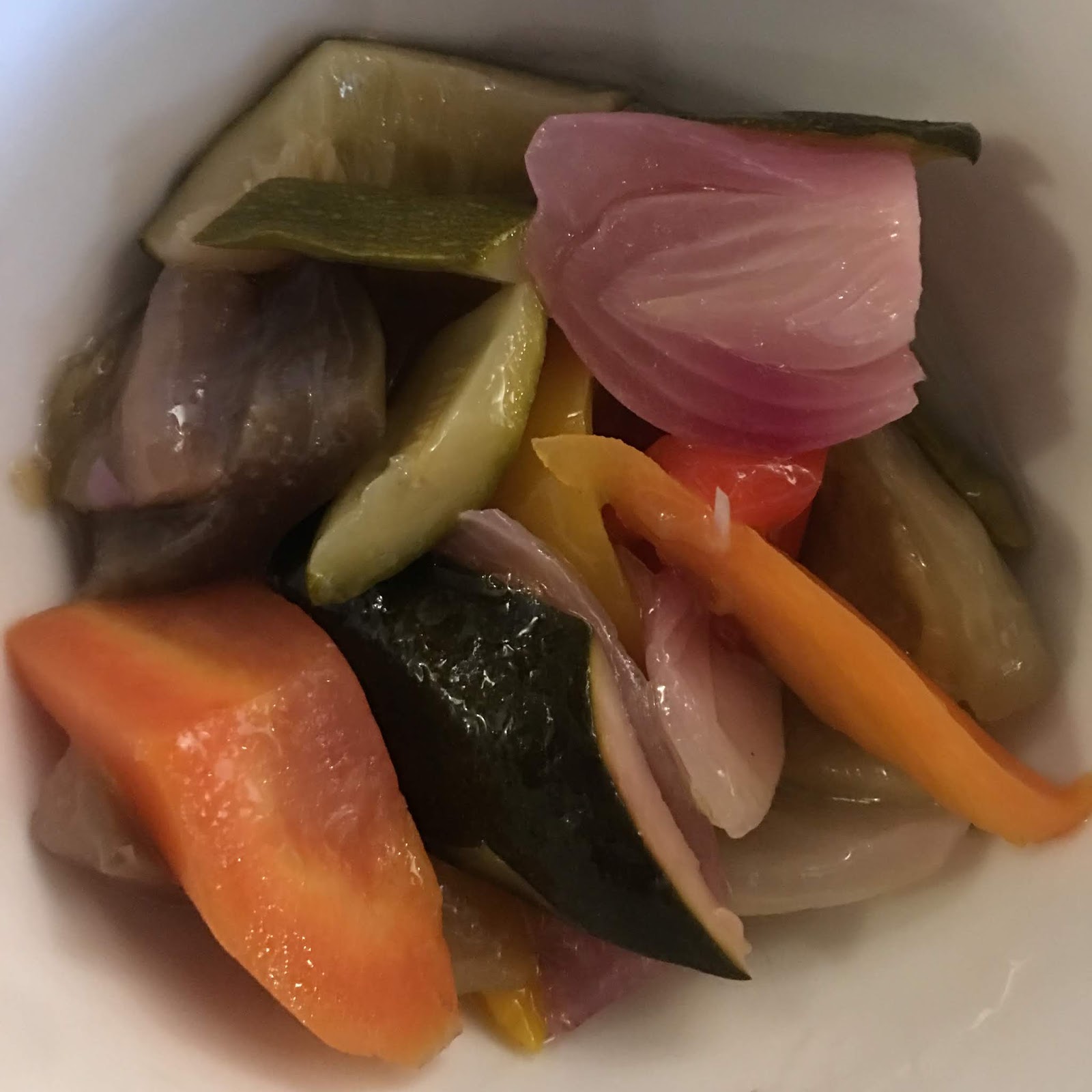
San Daniele, the village where the famed ham is cured has a small chapel, Chiesa di Sant’Antonio Abate. Built in 1308. Believe it or not it is a chapel to the patron saint of pork butchers. It is notable for it’s extensive intact frescoes painted by Pellegrino da San Daniele (1467-1547.) We had an outstanding lunch at L’Osteria di Tancredi. We began with San Daniele ham and wedges of two-month old Montasio cheese (cow’s milk.) And a small bowl of “agrodolce verdure”, which were red pepper, small onion, zucchini, carrot, asparagus marinated in oil, vinegar and local honey. We drank Pinot Bianco (from Strum Vineyard) and Collio Friulano (from Pascolo.) Then came Pappardelle with Anatra (duck ragu) and Tagliolini di Pasta Fresca Artigianale alla San Daniele. The pastas were memorable. As if mamma were in the kitchen putting all her love into the sauces. Dessert was a tiny glass dish two-thirds full with Bavarian Cream, one-third full with fresh cooked wild berries, then sprinkled with chopped pistacchios. I used Google Translate then memorized my lines.  I said: Noi siamo molto felici.  Ricorderemo a lungo la tua cucina. (We are very happy. We will remember for a long time your cooking.)
Agrodolce verdure


Before we visited those villages. Before we ate and drank all those things. On our first full day in Udine, we had lunch at Al Vecchio Stallo. Wes, during his trip research, found a wonderful book about Friuli. It has an odd genesis. An American pilates teacher visited Friuli for a conference related to the large rubber Pilates exercise balls. She fell in love with the food and the villages and the history and she put it all into a book. So for our first lunch, we, more or less, ate what she ate and where she ate it from, which was L’Osteria Al Vecchio Stallo. The building is a former horse stable. The interior is eclectic. Very sweet. Full of personality. And not a word of english spoken. Which was great for us. Impossible to be shy, we plunged in with our best effort at Italian. We were grateful for their patience and great suggestions. We began with Gnocchi di Sauris. Then Cjalsons. Then  fennel. And caponata. Followed by a plate of Frico with polenta. And a plate of salami with polenta. The gnocchi were made, not from potato, but from bread. Cjalsons are stuffed pasta. Take a circle of pasta dough, stuff with greens, fold over, crimp shut, boil, then serve grated with Ricotta Affumato (hard smoked ricotta cheese.). The fennel was braised. The caponata was stewed eggplant with capers, olives and tomato. Frico is a significant wedge of Montasio cheese seared to a crisp on both sides. It is served with polenta. But the polenta is white not yellow and is toasted and similar in appearance and texture to crustless toasted white bread. The salami was more sausage than salami. It was cooked in something tasty. All the dishes had sauces full of wonderful and sparkling flavors. I did not have the time nor the language skill to decode everything.  And I am certain all the recipes are in the book by the Pilates teacher with the most wonderful taste in food and destinations.

Wes and Marlow
Udine, Friuli Venezia Giulia
18 May 2019

Vienna: 14 May 2019

Steirereck restaurant, as seen from the park.
It is hard to believe that within are still the bones of a 19th century dairy.
Yes, we have been to concerts in Vienna. But we have also eaten.

This weekend, in the Stadtpark, there was a bio (organic) food fair. About fifty, maybe more, vendors set up temporary huts for a three-day stay. There was strudel.  There were wines and nuts and cheeses and breads and honeys and beer and children and dogs in leashes and dogs in buns and a golden statue of the waltz king, Johann Strauss and the ducks splashed in the lake and the trees were in flower with white and purple blooms and bulbs were sprouting tulips and there were green lawns lain with blankets and cotton chaises for the public to enjoy. The expected rain did not come. The sky was clear and the sunshine bright.

We walked through all that. We did not nibble. We were walking to a restaurant in the park. It occupies a former cow stable and dairy. But you would hardly know that as it’s east and west faces are modern, one side more, way more, than the other.  In our side, the restaurant designer envisioned fingers extended from a hand. In this case, several slender pavilions emanating from a central hub. Each pavilion holds about five tables. Each table has it’s own floor to ceiling window. On an optimal day the glass rectangle rises straight up into the sky. The table is exposed to fresh air. A long transparent scrim of fabric wafts in the open air breeze. On a day when all the windows are raised, the building appears, as seen from the park, to be sheets of shiny glass and stainless steel, at varying heights, reflecting the leaves of the trees and the sunlight.

Inside our slender pavilion, on our table was a hand woven linen table cloth. Earlier in the day, when I passed by, doing reconnaissance, I saw a man with a hot iron going table to table searching for wrinkles. Our table linens were perfect. That is part of what gets them two Michelin stars. And what gets them included in this years top 50 restaurants in the world.

I will say, the food was tasty. Every bite had an interesting aspect of flavor texture and of course presentation. I imagine anyone who has eaten in Steirereck when asked what stood out, will describe the bread trolley and the beeswax. For any fan of bread, the trolley is heavenly. Fifty breads, just out of the oven, still warm, with perfect egg-shell fragile crust. There were conventional loaves and things like chorizo-chile or honey-lavender. The bread-sommelier was an excellent slicer. A bag beneath his perforated cutting board captured the variety of crumbs. The beeswax refers to their fish preparation. Set one two-inch by four-inch rectangle of arctic char in the center of a silicon mold. Next, pour a small pitcher of molten beeswax over the fish. When it hardens, remove the silicon mold and the beeswax. The fish by then has been cooked by the hot wax. It is then taken to the kitchen to make ready for it’s table presentation.

Whether we had venison, fish or celeriac they were all accessorized with something crispy, something creamy, an interesting vegetable. The unifying concept was the quality of the ingredients. For instance, and this is not particularly food related, after lunch we saw people on the roof. They were laying out flat vacuum packed bags to lay in the sun. Later, I read in the Steirereck Magazine, a rather thick interesting compilation, that they gather in the forest a particular herb. They pack the herb with syrup, lay it in the sun, wait a month, then filter the resulting syrup into bottles with droppers. It is good for soothing coughs. And it is good for adding a sparkle of flavor to a plate. That is the appeal of Steirereck. There are many inventive, creative, hand-wrought elements.

Our most frequent food hangout is the Café Imperial, the corner café of our hotel. People in the know on Vienna, will suggest Hotel Sacher or Demel’s for a pastry café experience. But our Café Imperial is as old and venerable as the others. The others, in my view, have been somewhat ruined by the internet. Yelp and Trip Advisor have sent tourists, to the classic places, in numbers greater than they can accomodate. What used to be special, intimate and classic is now a mob scene. The lines are long and slow. The clientele is mostly touristic. So are you really in a Viennese place if the patrons are not Viennese?

Our Imperial has vey good edibles, sweet and savory. Plus where else will you bump into Cecilia Bartoli. Or Valery Gergiev. Or Frank Peter Zimmermann. What? You do not know Frank? He is another of my favorite violin soloists. I have watched/listened to him for hours on Youtube.

Tonight, we heard him play with his string trio. The played in a smaller hall than the Musikverein. And one, perhaps, more elegant. Not so gold and flashy. Understated elegance. Earlier today, we saw Frank and his two trio colleagues on the street with their cases. Online, you learn they each play on an instrument by Antonio Stradivari.  I think they should not advertise that while they walk down the Ringstrasse in Vienna. That is a fifteen million dollar heist waiting to happen! In any event, they passed us in the Imperial. And in their concert, they sounded like a million bucks.

Wes and Marlow
Vienna
14 May 2019

Friday, May 31, 2019

Vienna: Wednesday, 8 May 2019


Wednesday, 8 May 2019
We are seated outdoors under cover of an awning with heat lamps. It is still daylight. Across the street is the Vienna Konzert Haus. Another block away is the Musikverein, the home of the Vienna Philharmonic and the room where they were led by Johannes Brahms and Gustav Mahler. Within a radius of six blocks are the apartments of Beethoven, Mozart, Schubert, Schoenberg and Erich Wolfgang Korngold. We are in one of the few "ground zeroes" for classical music, where it's creators masterminded our musical equivalents of the Mona Lisa.  But just now, before the week of concert going begins, we are eating traditional Austrian food: beef gulyas, kartoffel (potatoes), herring, strudel and grüner veltliner (dry white wine) and beer (which has an aroma of hops flowers).

We left home Tuesday and arrived today, Wednesday. Our flight was near eleven hours. Do not feel sorry for us. We did not rough it. It was not cramped. It was not noisy. We were in spacious seats. Large electronic easy-chairs. They fully reclined into flat beds.  If one must endure a long flight, it is best to be on the intimate and cozy second floor of a 747. We slept some, but not more than a few hours.  The time "flew" by.

On arrival, we were met at the Vienna airport by a car. Twenty minutes later we arrived at the Hotel Imperial. We have stayed there once before. Then as now, our windows look across to the hallowed Musikverein concert hall. Last time our room was beautiful, spacious and comfortable in every way. This time it is the same, but double as our room is a one-bedroom suite. The walls are upholstered in blue brocade fabric. The blue, satin, floor-to-ceiling drapes hang twenty feet. Our ceilings are that tall. They have to be that tall to accommodate the large crystal chandeliers.

After a walk after dinner, there will be a hot bubble bath, followed by a good long sleep.

Wes and Marlow
Vienna, 8 May 2019


Casey in flight.


Casey in the Elizabeth Suite, Hotel Imperial, Vienna


When we desire a refreshment, we find it in the hotel bar.

Vienna: Anne-Sophie Mutter; 9 May 2019


We picked Vienna, for this trip, in part for the grand hotel availability and also because it is feet away from the Musikverein concert hall which is a hive of outstanding classical music events.

When I was a boy of ten I heard live and up close a violin. It was played in a small elementary school auditorium. The player was a girl two years older than me. I loved the sound from the first note. A year later, I lived across the street from a public library. After I discovered they had a listening section where I could enjoy their classical recordings through their headphones, I spent as much of my free time there. I could tell you the exact pieces I listened to. I listened to them over and over. Each time, I noticed more details. Eventually, they became my agreeable friends. They brought enormous comfort, pleasure and satisfaction.  Classical music still does that for me.

Our first concert was the violinist, Anne-Sophie Mutter. The first time I hear her, thirty years ago, was on a car radio. I was rapt and enthralled enough that I pulled over and parked the car to be able to focus entirely on her. It was a thrill to hear her here.

The Musikverein was built in 1870. Vienna had an Emperor, Franz Joseph. A music club, formed in 1812, the Gesellschaft der Musikfreunde, asked him for permission to acquire land and funds. 1870 was the year in which the Emperor decided to pull down the medieval fortified wall that had encircled old Vienna for 500 years. He was aware of what urban renewal had recently done for Paris and Barcelona when the ancient crooked narrow streets were replaced with straight wide boulevards.  The medieval wall came down. In it's place was the elegant "Ringstrasse," ring road. Extra wide. With rows of trees. It became the place to be. The elite, the wealthy, the aristocrats races to build palaces their. Our hotel, the Imperial is one of those buildings. And the Musikverein, next door, is another.

The Musikverein creates an immediate impression. You cannot enter the grand hall and remain calm. It is splendid and gold leafed and hung with crystal chandeliers. Your eyes never rest, there is so much to see and it is all so gold. The architect spent eight years in Athens. If you have been to the Acropolis to see the Parthenon the you know the basis for the Musikverein's design aesthetic. Today, the Parthenon is a unadorned structure with many missing parts. In it's day, it was heavy laden inside and out with statues and brilliant surfaces. It's inner sanctum was a temple, a shrine, a sacred place. That describes the Musikverein's interior. It is quite over the top, but it's splendor impresses that you are in a special place.

Anne-Sophie Mutter is 56 years old, slender and blond. She always wears a gown without arms or straps. The wood of her Stradivarius rests directly on her bare shoulder. She is not a showman, which is to say, she does not smile, nor does she put on an extrovert show of movement for effect. Playing a violin concerto, particularly at her superior level, is a highly precise, athletic, technical feat. You could say, it is walking a tight rope without a net. I am not bothered, nor disappointed by her serious demeanor.

She was accompanied, in her Mozart program, by the Kammerorchester Wien-Berlin, which is an elite small group of players drawn from the Vienna Philharmonic and from the Berlin Philharmonic. The Kammerorchester is what they do in their time off.

The orchestra played a few pieces alone then were joined by soloist. They played Mozart's first symphony. He wrote it when he was eight years old. Mozart was a local composer in his day in Vienna. (So were Beethoven and Mahler and Schubert and Korngold.) Anne Sophie played Mozart's second and fifth violin concertos.

Her sound is easy on the ear. Often, she will play at whisper, so softly you could wonder if she would be heard by the back rows. But her touch, her way of pulling the bow across the string coupled with her magnificent Stradivari violin, (she owns two,) ensures her sound floats like a ray of golden light into every ear in every seat. After her last notes, the audience, which in Vienna, to me, seems reserved and a bit unsmiling, loved her. The applause would not stop. And finally she gave us her own smile.

An hour before the concert, I sat in our windowsill, looking across the road at the artist's entrance for the Musikverein, when she arrived. She was in casual clothes, maybe jeans. She had two men with her. One carried her garment bag. The other had her pair of small dogs. She gave them kisses then went inside to play.

Marlow and Wes
Vienna, 9 May 2019


Two of our concerts.


A handsome concert goer.


A Stradivari and a smile.


This is a photo from the Musikverein website. In person, the gold leaf, on every surface, shimmers and gleems.

Vienna: Fairy Tale Evening: 13 May 2019


Today, Monday, we woke up, dressed and went down to breakfast. I had a petite omelette customized with mushrooms, gruyere cheese and sprinkled with freshly snipped fragrant chives. A few tables away was a familiar face. Our concert tonight featured Cecilia Bartoli. And there she was with her husband and her mamma. She travels with her mamma.  Which I think is achingly sweet. There is a video, on YouTube, in which Renata Tebaldi describes her life. She never married. Never had children. Because her voice was her life. She felt an obligation to serve her voice to the exclusion of more traditional desires. And she travelled the world with her mamma. Mamma Giuseppina was her name. In the interview she tells of a time in New York City at the Metropolitan Opera. Her mamma became ill, seriously ill. Renata was distraught. She did not want to perform. She said later, when "mamma died, I did not ever want to sing again."  When I saw Cecilia Bartoli with her mamma, I thought it sweet and special beyond words.

We knew Bartoli was in our hotel. Our dear friend in her orchestra had told us. He encouraged us to speak with her. So I did.

I simply wanted to pay humble respects to one who excels in her field. She was kind, receptive, warm and both she and mamma extended their hand for a gentle shake. She told me she was pleased with the programming: all Vivaldi. Songs interspersed with movements from the Four Seasons violin concertos.  She hoped we would like it.

The concert is now over. It was in the golden grand hall of the Musikverein. We sat on the stage behind the four violas; close enough to take a few steps and turn their pages, which we did not do. The concert was entirely sold out which meant 1,700 people seated and another 300 people standing. Sitting on the stage is not ideal for a perfect blend of sound, but it is an outstanding visceral experience. We were in the center of the action. It was thrilling.  The concert ran two hours and forty-five minutes with one intermission. Each half played as a continuous stream of movements. Every piece segued into the next.

Cecilia Bartoli is a charming stage presence. She sings directly to the audience. She looks at them. At times she walked the aisles singing to them. From the stage, we looked directly, fifty feet away into the eyes of her mamma in the twelfth row. I got the sense she loves to sing for her mamma. Before too long, it seemed the audience's pleasure evolved into affection. By the end, it was a love fest. And Bartoli was ready to reward us. She had encores, lots of encores. One encore involved a primitive trumpet. He played some wild flourish. Then she matched it. The one upmanship went on and evolved into Gershwin's Summertime, then somehow got back to Vivaldi.

The encores occupied thirty minutes. At the end, we found our friend from the orchestra. We followed him through corridors and up stairs to a reception hosted by the Monaco Consulate. The room was smallish. Filled with the twenty five musicians, a handful of diplomats and administrators and us, the party crashers. Wes sipped wine while the Ambassador to Monaco complimented him on his exceptional performance. He accepted her compliments. After a while, several glasses of champagne, mini-apple-strudels, and chocolates in the shape of the crown of the Prince of Monaco, Cecilia Bartoli entered. Applause. She was brought to the front of the room. She saw me, her eyes widened, she smiled, and asked me if I liked the programming she described at breakfast. I thought, gosh, she has a good memory. She just sang a two and a half hour program for two thousand people and she remembers me from breakfast? Perhaps that is what makes her special. Apart from the exceptional talent and accomplishment, she has a gift to connect with people.

Before we left, I introduced myself to the viola players. I was afraid I would be shy and clam up. They were warm, open, friendly and I was grateful to get acquainted. It was an international group of musicians. One was from Amsterdam, another from Helsinki, and Italy and France and Switzerland. I watched them switch languages effortlessly from English to Italian to French to German. At the end of the reception, I said to Lorenzo, "you take us nice places." And at the end of the evening, back in our elegant Imperial Hotel suite, I said to Wesley, "you take me nice places." What an understatement.

Marlow and Wes
Vienna: 13 Monday 2019
Cecilia Bartoli Concer

Thursday, November 30, 2017

Luang Prabang, Laos - November 16 - 20


Another great hotel.  This is starting to feel decadent. Constant hymns of praise to great hotels. Is the trip about seeing new elements of the world? Exploring truly foreign lands? It is. But Southeast Asia seemed so foreign and it is our first time coming. The safety and comfort of special hotels seemed warranted. Maybe next time — now that I, the fraidy cat, am familiar; now that the air of mystery has lifted — we can go less luxuriously.

That said, the Azerai Hotel is an oasis of beauty and calm.  Right in the thick of things. Next door to a temple. (Though, here, everything is next door to a temple). Near to the confluence of the Nam Khan and the Mekong Rivers. Across the street from the night market, a road with nearly one hundred street vendors. Their offerings are a mixed bag. Baggy pants in an elephant print; same ones sold in Sri Lanka and Thailand. Spoons and medallions made from the melted metal of American bombshells. But also there are beautiful hand loomed silks and traditional clothes, finely made. Eventually, you get past the vendors as you approach the confluence of the rivers. The small streets and smaller lanes and alleys become a neighborhood of locals. There is, without question, a large tourist element here, too. Guest houses, restaurants, bars. But as you pass open doorways, there are local families tending their children, making dinner, doing their laundry, sitting with their feet up, the men shirtless, electric fans blowing, folded fans waving.

One of our best experiences was on one of these narrow lanes. There was a store front. It's doors were open. It's porch was wide. It was teeming with kids; younger and older than twenty years. A Frenchman stopped us. "Will you come in for a moment. Talk to the kids. They are learning English. They love to practice with foreigners". We stepped up to the porch. Sat down. Instantly, we were surrounded with eager, shining, bright eyed faces. Their stories were similar. Lots of siblings. They start work at six in the morning. They work six days a week. They work hard. They do not complain. They feel better English language skills will improve their employment prospects. Their passion was palpable. It became a mutual admiration society. We wanted to experience a new culture. They delivered new culture to us. They humanized, for us, every subsequent Lao we met.  The program is BigBrotherMouse.com

Luang Prabang is a UNESCO World Heritage Site. Our hotel is new. The new construction required conforming to the dimensions of the previous building. That is a good thing. Because of that, the hotel is a low profile two story rectangle with a large central open space filled with a large refreshing pool. We dipped several times a day. Like a broken record, I restate, it was hot steamy humid. Our room was on the ground floor in a corner. Behind us was a temple. Our first morning, we woke before sunrise. We heard a faint drum pulsing. Also we had a date. We requested to deliver rice to the passing monks at 6 AM. We went to the lobby. They had a basket of warm sticky rice for each of us. They had set a cushion on the sidewalk so we could comfortably kneel.

Since we began the Southeast Asia portion of the trip it has been an immersion into the world of Buddha. As our esteemed new nephew army officer in Sri Lanka put it, more or less, Buddha does not have to be a religion, it can be an idea of meditation and contemplation of the basic needs of humans and serving something other than yourself. On almost every street there is a temple compound. Each one has a population of novices (monks in training) and monks in residence. Life as a monk involves giving up worldly possessions and desires. Reducing their existence to the essentials. As few possessions as possible. Their needs are shelter: as little space each as nine by seven feet. Clothing: more when it is cold or buggy and less when it is sizzling. Their garments are a two rectangles of fabric; one wraps around the waist, the other creates a toga effect with the right shoulder exposed. The colorful fabric is natural fiber, hand made. The dye is from bark or stones or plants. The color varies from city to city. In Luang Prabang it is brilliant orange. Food: only enough to sustain the body and eaten only before noon.

Every day, they rise before the sun. They line up in order of age. They prepare their special bowl for the alms they will receive. It is forged from eight thin wedges of iron and fired five times. It stays with them for as long as they are a monk. For some it will be a lifetime. After chanting and pulses of the drum, they step out of the temple grounds and on to the city streets. They are respected. People know to ensure their heads are lower than the monks's heads. If people sit on the ground, they know to aim the soles of their feet away from the monks. The same goes for being in the presence of a Buddha statue. From our cushions in front of the Azerai, we know they are approaching because at the corner it looks like a paparazzi feeding frenzy. Like piranha. Chaos. We begin pinching the sticky rice into balls. When they walk by us, they will not stop, only slow down enough to raise the lid on their bowl. Suddenly, they were upon us. They passed faster than we'd anticipated. Take a deep breath. It will all be fine. Get in sync with their rhythm. One monk. Next monk. Another monk. So far, so good. We could not look at their faces, so preoccupied with putting the rice ball in each bowl. And that was okay because one of the 227 rules of conduct they commit to does not encourage smiling or eye contact. It would be immodest. They might be tempted to enjoy the attention. As the lined neared it's end, it was hard to keep our heads lower than the monks's because the final few were little children. It is expected every boy will, before the age of twenty, live as a novice monk. It brings honor to their family. Plus it is, for the less able families, a guaranteed education for the child.  Maybe it was the early hour. Or the surreal sight of photo hungry people who took our picture while we waited for monks. Or our fingers molding warm rice into balls. Or the face-to-bowl encounter with people and children who say no to possessions and ambition and competition and poverty; how can you be poor when you desire no possessions. Money loses it's power.


That was the morning. We were done by 6:30 AM. There were two other hotel guests who gave rice. A conversation began and we ended up joining them on their day of waterfalls and caves. An hour later, we were together on benches in the back of a bouncy pickup truck racing through rice harvests toward the falls. After 45 minutes, we arrived at the parking lot for Kuang Si Falls. It was also a food and souvenir area. We parked in front of our driver's mother's concession of flip flops and coconuts. She had tiny customers.


As for us, we had an eager beaver. Let's go!


The falls were splendid. They fell from on high. Not huge like Niagara, but still wonderful to feel the spray on our faces.


We followed a staircase up. It went this way and that. It ascended parallel to the falls. Near the top was a place for a swing and a dip.


We saw a sign for a cave and decided to go farther.  In all we walked several kilometers to the cave entry. There, the ticket man gave us each a flashlight and a tiny banana. We ate the bananas. The man said something. We didn't know what.  Once up top and in the cave, we knew he'd said, "the banana is your offering to Buddha".

On the way down, we met a pig. Say hi.


Back down the hill, and at a lower level of the falls, where they settle into pools, we swam in celadon water. The setting was paradise. Was Eden more beautiful?


We got back in the truck and bounced ninety minutes over rutted dirt roads to a village, it was smaller than a village. It had signs: "healthy village," "crime-free," "village women union - 3 aspects to be considered as good".


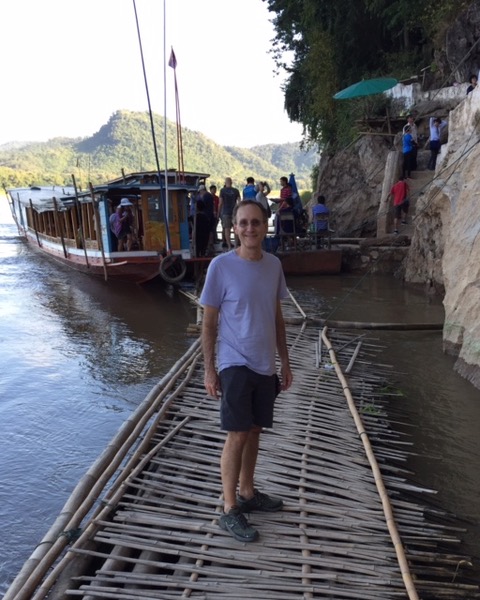
A woman offered me a sip of her rice whiskey. We bought tickets there for a short boat ride. Across the river, we ascended stairs and stairs to caves with assemblages of small Buddhas.


Then back to the boat, across the river, back through the village. Children played games from their imaginations, like children would do anywhere on the globe, laughing and tumbling. In straw half dome baskets, birds were kept from escaping dinner. Chickens pecked and clucked. Then back in the truck bed. Bounce bounce bounce. Dust clouds. We stopped to admire the sunset view over the river. Around the bend an elephant came walking. A teenage boy walked nearby. He was the boss. If the elephant ate foliage for too long, one word from the boy made him straighten up and walk. As they approached us, the boy climbed up on top. Good thing, too. People see elephants and think cute. This week, a dose of reality was served in the Chiang Mai Zoo. An elephant tired of his long time keeper. He rolled him up in his trunk and squeezed the life out of him.


One thing I have not mentioned, is the prevalence of cold fragrant towels. In Thailand, Cambodia and Laos, the hotels greet us constantly with cold damp towels, typically scented with lemongrass oil. They are the best.

One day at the Azerai, we met a yoga master. She teaches in San Francisco, East Hampton and elite hotels around the globe. Earlier, at one of the caves, we interacted with her boyfriend, a cheese master with great and welcome enthusiasm for Siem Reap. Later, we got acquainted.  Her brother is a major music person in New York. I have known his name for many years. Before they departed the hotel, she posed on her head at the pool for a half hour for a few souvenir shots.  The Azerai was an outstanding watering hole. Four new friends.

On our final day, we took a boat across the Mekong to visit the Botanical Gardens.


It has been open eight years. Young for a garden of it's type. It sparkles. It has fine paths. The open-sided teahouse is beside a lotus pond. The gift shop sells handmade traditional Lao objects, useful things. The plants are well marked. All it needs is time to grow. While we waited to board the boat across the river, an orchid master explained the vanilla producing orchid to us.

Later in the day, we walked on the riverside as the sun set on the Mekong.


Next stop, Siem Reap, Cambodia and Angkor Wat.

Wes and Marlow
Luang Prabang, Laos
November 2017