Paris, 2009 (photo by Roland Kato)

Paris, 2009 (photo by Roland Kato)

Friday, October 6, 2017

Granada, September 20-24, 2017


Granada, our next city is like a dream. On one of it's hills is the Alhambra, which is a combination of fortress, village and royal palaces.

Here is a bit of very general backstory. In the year 711, people from north Africa, we will call them moors, islamic moors, flooded into Spain. They took possession of the entire Iberian peninsula except for the north coast. They displaced what we will call the Spaniards, christian Spaniards. The Spaniards battled the moors until 1492. The Spaniards won. The final conquering occurred in Granada.

The early arriving moors, in the 700's, made outstanding settlements in Cordoba and Seville. They created buildings with extraordinary interior decorations. Though they had inhabited Granada from 711, it was during the 1200's when the sultan ordered the creation of the Alhambra.

They erected buildings which from the outside are large, plain, stone rectangles. The
interiors were, and remain, decorated with elaborate and extreme plaster work. The walls have geometric designs engraved in the plaster. The ceilings have what resemble stalactites crafted from thousands of plaster cylinders affixed to the ceiling and carved to create the effect. The outdoor spaces which connect the buildings have reflecting pools, fountains and slender troughs embedded in the pavement. The water comes from the melting snow on the Sierra Nevada. The moors crafted an intricate system of aqueducts and cisterns and valves; and they constructed their water features according to elevation so each pool and fountain could feed the lower ones. The water enables verdant gardens of trees, hedges and flowers. It makes the ambiance cool on hot days. And the water supplies a continuous sound. A Spanish composer, Francisco Tarrega, wrote Recuerdos de la Alhambra for solo guitar, to reflect the hypnotic beauty of walking through the Alhambra.  
We walked through it twice; once by day, once by night. On our night in the Alhambra,
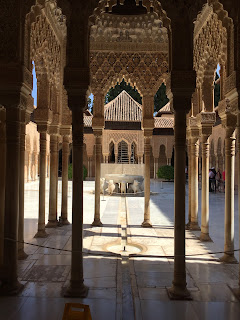


the moon was shining. The ornate interior facades were mirrored in the still water of the reflecting pools. The air was cool. We shared the space with very few people. The sultan's palace has buildings for various purposes. One for receiving solicitors. One for entertaining. And one, the most intimate and lovely, the courtyard of the lions, for his residence and being with the harem. The courtyard is lined with elegant slender columns, far more than necessary, over one hundred.  They constantly divide your vista.  In the center is a fountain supported on the backs of twelve lions. Twelve lions: one for each month, each hour of the day, each sign of the zodiac, etc. The lip of the fountain is engraved with a poem. The poem extols allah, over and over. A significant portion of Alhambra's the engraved plaster wall decoration consists of the written word, allah.

Our hotel, the Parador San Francisco, is part of the Alhambra. When Queen Ysabel and
King Fernando won possesion of the Alhambra from the last sultan, they kept most of the buildings intact, but a few they razed or repurposed. Our hotel was that way. A few bits of the hotel had the islamic moorish decoration, but the remainder of the building was a monastery built by the Spanish in the early 1500's.  In it's beautiful courtyard, there is a photo of the building from 100 years ago. It was falling apart, in extreme disrepair. The intervention was made just in time to save all the buildings of the Alhambra.

There is an oil portrait of Queen Ysabel in the lobby. It is not attractive, not something
you'd expect a monarch would approve of. When she died in 1504, she was interred in the islamic part of our building. She and later her husband remained there until their grandson completed, down the hill, the Capilla Real, where their tombs are today. Referring back to the Prado and the Rogier van der Weyden painting, a copy of it hangs facing the marble royal tombs in Granada. There is a funny aside regarding these tombs. Laying beside the king and queen are their daughter and her husband. Folklore says, the daughter's husband, Felipe "el Hermoso", died and a priest convinced her he could revive him so she traveled with her husband's corpse for several years, occasionally lifting the lid to have a peek, until she was declared "loca"  Juana "la Loca".

Before visiting the Alhambra, I read Tales of the Alhambra, by Washington Irving. It was like a book of fairy tales and Arabian Nights stories. He lived in one of the palaces in the 1828, when the buildings were in extreme disrepair, when they served neither royal nor political functions. He wrote of looking down to the river, where at night there was always life going on and the sound of the guitar.

There is still the sound of the guitar in Granada. We went to a flamenco establishment,
Peña la Plateria. It functions as a private club and a flamenco school. On site there is a terrace restaurant. We ate Spanish home cooking of simple foods: beans with ham, gaspacho, eggplant with honey. Afterward, we paid our ten euros, sat indoors at our table and enjoyed a young man and his guitar. He mesmerized us for a dozen minutes when a dancer came out to accompany him.

In the twentieth Century, the leading Spanish guitarist, famous enough to be called by one name, Segovia, began his guitar instruction in Granada in 1900. There is a recording of him sharing, in English, his recollections of the streetcars, the bougainvillea, the lovely girls, the magical Alhambra in the moonlight and the sweet perfume of the orangeblossoms. We have been there and every thing he said is still true.

Wes and Marlow
Granada, September 20-24, 2017


Thursday, October 5, 2017

How we packed for 11 weeks of travel ...


Two carryon bags for each of us!

Madrid, September 18-19, 2017

We are on the road, in celebration of our sixtieth birthdays, traveling in an eastward direction, for eleven weeks, until we arrive home in mid-December.

Our trip began in Spain. We departed from Los Angeles on a Monday morning and arrived in Madrid on Tuesday morning.

We have been, several times, to Madrid. It has several attractions which I probably would never tire of. It also has a sprawl, like Los Angeles, which makes it cumbersome to get around. This time, as usual, we focussed on the intersection where the Prado Museum is located. That is also where the Hotel Ritz is and that, to my total and happy surprise, is where we stayed.

We were tired and it was so very nice to be pampered on arrival. While our room was prepared, we were seated in a room with chandeliers, velvet upholstery, an arrangement of lilies almost the size of us. From small comfortable chair we reached out to the small round table for coffee, cookies and hot chocolate, which in Spain is typically dark and thickened to an easily drinkable pudding.

Our room was fun to explore. The window opened onto a vista of leafy trees. Down below was a dining garden with bougainvillea and fountains. The bathroom was equipped with a bathtub, deep and long and a separate stall shower, clad in marble. There were soft towels in small, medium and large with raised nap which spelled, R I T Z.  The bath products were Wesley's favorites, made by Penhaligon of London. The colorful carpet was woven with designs of floral sprays and garlands. In it's corner was an embroidered name and date by it's maker, I assume. The bed linens were exceptional. Far beyond Egyptian cotton and percale and sateen damask, they were woven of linen with delicate embroidery and ironed, cool and crisp to the touch.

We were in Madrid for one night only. Our free time, we spent in the Prado Museum. We walked through the room full of large regal canvases by Velazquez. Was he doing respectfully accurate portraits of the king? His features seem goofy and comical. Or maybe the king was not classically handsome. Of course, we stood before Las Meninas. There is so much going on in the large canvas: royals, pet dogs, children, a dwarf, the painter himself, mirrors which reflect people not otherwise visible in the room. We wandered through a lot of galleries without searching for particular painters or paintings. In the Prado, you can do that and in every gallery you will find masterpieces. We always make a pilgrimage to see a masterpiece recommended by a dear friend. The painting is The Descent From The Cross, created by Rogier van der Weyden in 1435. In it, there are life size people in brilliantly colored robes. They look perfectly alive and as if they could turn and talk to you of the sadness.  The subject is religious, but the feeling is universal that humans empathize with each others trials and struggles and pain. (This painting will figure in our next city, Granada).


The hotel breakfast was another great pleasure. It was a fantasy spread of perfect items. The juice, fresh squeezed; the honey dripped from it's inclined honeycomb; the olive oil fried eggs with perfect yolks. Anything else we desired was available from a menu or the server.


After breakfast, we checked out and from the Hotel Ritz, we walked, past the Museo del Prado, to the Atocha train station. The station consists of it's original old atrium, no longer with train tracks and a modern addition where the trains arrive to. The old atrium, from the mid-eighteen hundreds consists of an iron frame, (created by an associate of Gustave Eiffel), with attractively paned glass. Twenty-five years ago, it was taken out service and repurposed as a lush garden of palm trees and occasional ponds with turtles and fish. Abutting it's front end is the modern terminal where we boarded a train for Granada, a city in the southeast of Spain.

See you in Granada ....

Wes and Marlow
Madrid, September 18-19, 2017


Tuesday, June 14, 2016

Resources - Sicily and Puglia


We have compiled lists of tips and various resources in response to inquiries regarding specific places or events mentioned during our travel in Sicily that we would particularly recommend.  We have not attempted to list every restaurant or accommodation - only those that stood out and that we would love to return to.

Accommodations
  • Siracusa - Apartment in Ortigia in an ideal location with a view of the sea but not located on the busy perimeter of the island.  Spacious with nice furnishings and attention to all details.  Owner was helpful and responsive.  Located up a few flights of stairs but worth it!  You could just stay inside and enjoy the space.  Highly recommended.  
  • Modica - Casa Talia.  Extremly comfortable inn with self contained units tucked into the hillside, outstanding views and lovely gardens.  Modica is well located for exploring the Southeast of Sicily and is convenient to the nicest beaches.  The inn is located above the heart of the town which provides more convenient access for day trips by car than having to drive through the congested center.  But the center is only a ten minute walk downhill.  We stayed in the Scirocco room which was ideal.  Highly recommended.
  • Etna area - Monaci delle Terre Nere has a good location fairly high up on the East side of Mt. Etna with expansive views out to the sea.  Nice swimming pool and yard for relaxing.  Onsite restaurant is overpriced and not recommended.  There are probably better options than this hotel in the Etna area but we were comfortable there and enjoyed relaxing at the pool.
Accommodations - Puglia and Tropea

Restaurants (click on link for address and other information)  Many restaurants we visited are affiliated with Slow Food.
  • Ortigia (Siracusa):
    • Caseificio Borderi Sandwiches made to order using fresh ricotta and other cheeses.  Located in the market.  Worth the wait in line.  Also interesting and entertaining to watch.
    • La Gazza Ladra (Slow Food)
    • Enoteca Solaria Nice option for the aperitivo hours.
  • Scicli: La Grotta   (Slow Food) Highly recommended.


  • Portopalo di Capo Passero: Ristorante Scala (Slow Food) Highly recommended.

  • Tips

    • Lunch seemed to start at 1PM and last until 3PM.
    • We preferred to have our main meal at lunch since life since many shops and sights are closed during the lunch hour.  This habit also fits nicely with the aperitivo practice where many bars and restaurants serve ample snacks along with drinks during "happy hour".  
    • Restaurants are happy to split portions between two so we would often share ("condividere") a pasta or other "primi" and then each have a meat/fish/vegetable course.  It is also completely acceptable to only order from one section of the menu.  You do not need to order both a primi and secondi.
    • The Slow Food app for iPhone includes a map feature whereby you can easily find affiliated restaurants in your vicinity.  We made extensive use of this app.
    Miscellaneous
    • We arranged our rental car through Autoeurope as we have many times in the past.  We have never had a bad experience with them and found their rental rates to be far below other options.  They e-mail a voucher which needs to be presented to the actual rental car agency (Hertz, Avis, Europecar, etc.).  They also will match lower prices that you may find after you book the rental.  For example, I check their listed rates, as well as the rates of their sister company Kemwel.com, after I make the initial booking and often am able to reduce the rental cost even further.
    • You will hear many people counsel you to not drive in Catania or Palermo.  We ignored this advice and drove in Catania and it was a mistake.  It was very challenging (frightening actually) and there seemed to be no attention to normal rules of the road.  Do not attempt it!
    • Driving in the rest of Sicily was fine.
    • The Sicily travel forum hosted by trip advisor is a great resource.


    Wednesday, June 8, 2016

    Heathrow Airport, 6/8/16


    Our journey has concluded. We have had another outstanding adventure. It unfolded like a rapturous feast, the kind seen in movies like Babette's Feast. A series of superlative offerings. Set in the perfect order.  Each offering topping the previous. Ecstatic traveling. That is the Wesley/Casey way.  If someone asks, as many will, reasonably so, what was the highlight of the trip, I can only say that what began as an outstanding trip got better every day. Everyday, everyplace was the highlight. And now we return from a dream trip to our dream of a home. The world, our globe, is wonderful, especially so in the smaller cities, the villages, the historic centers. Only a week ago, we stood on a mountain top in Agrigento. The sun, in it's last hour, illuminated, and bathed in golden light, the temple we stood to admire. From there, the hills rolled down to the southern shore of Sicily. Two-thousand six-hundred years ago that temple was surrounded by people. On an individual level, their cares were similar to ours. They desired good health for their loved ones and for them to be happy and satisfied.  It is a satisfying and reassuring part of travel to see, everywhere, humans wanting good for other humans. It is a great privilege And pleasure to crawl to the far corners of the world and find good there.

    Wes and Marlow
    Heathrow Airport, London
    June 8, 2016

    Taormina & Etnea, May 29


    Between CATANIA and our next destination, the up-market inn, Monaci delle Terre Nere, in ZAFFERANA ETNEA, we have several hours to fill, before our room is ready. We will drive north on the west coast to make a short visit to TAORMINA.

    TAORMINA is nestled on a steep hill with a view that has made it a must see town for at least a century. It sits atop a mountain. It's main street is narrow. The streets that cross it are even narrower. Those cross streets, on one side ascend the mountain. On the other, they descend and end with a vista of the sea. They are all, picture postcard perfect, with cobblestones and bougainvillea. Add a little blue sky, some puffy clouds, sunshine, maybe a cocktail or scoop of gelato, and life feels very good.  Our moment in TAORMINA is on a weekend. It is busy. There are many people. Wes leads us through the streets, past the small, black lava churchs and through the elegant gates of the Hotel Timeo. Then through the elegant lobby and out to the expansive terrace where at the rail where the terrace ends there are large pots of bright red geraniums. Beyond them are palm trees, and bougainvillea, and vistas of the town ascending the mountain, and of the sea, and of, the star attraction, Vulcano Etnea, The Etna.  

    The Hotel Timeo is elite and expensive. The terrace is not crowded. We sit at a shaded table facing the view. The waiter takes our order. He returns with a juice concoction where the bowl of the goblet is first lined with mint leaves, then filled with crushed ice, then juice of blood orange and passion fruit. It is garnished with a stem with nine tiny red currants and two long swirls of lemon zest. It is tart and perfect in the warm weather. We also have a goblet with two flavors of granita: strawberry and lemon. The strawberries here have a particularly exotic, perfumed aspect. To wipe our dainty fingers, we have tiny beige ironed linen napkins. And there are patatine (potato chips), hazelnuts, salted almonds and plump green olives. Life is good at the Hotel Timeo overlooking The Etna from TAORMINA.

    From the Hotel Timeo, en route to the car, we visited a ceramics shop. Wes recognized, through the shop window, the work of Giacomo Alessi from CALTAGIRONE. The shop owner had a broomstick across her shop door while she ate from her bowl of spaghetti with eggplant. She sensed we were in a buying mood and let us in. A few minutes later we walked out with five small pieces. She was happy and Wes was, too.

    One hour later, we arrived to hotel known as, Monaci delle Terre Nere. The name is great practice in Italian pronunciation of the letter "e", which sounds like the "ay" in hay. Delle Terre Nere, goes like this, repeat after me, day-lay tay-ray nay-ray. Bravo studenti! The hotel occupies many sloped and hilly acres, most of which are orchards of kiwi, cherry, apple, fig, olive, apricot, peach and orange trees. The buildings include and old two-story mansion and several new out buildings which house the majority of the rooms. Between the buildings, there are terraced green lawns and a pool for shallow swimming, and chaises.

    In just five years, they have built up a loyal clientele. There is so much that is good, that the few things that seem off, stand out to me in stark contrast. I will only mention one of them: the music which played loudly in their esteemed dining room, from a speaker three feet from my head, was American. We are in Italy. I am absolutely thrilled for my hosts to share with me what they love most about their country. That is not their management style. On another level, the staff which takes care of us has some wonderful members, such as Veronica. During our short stay, we have seen her doing excellent work at poolside, in the reception room bar and taking care of clients during dinner. She gets a gold star!

    Today, we made an excursion. We drove half-way around The Etna. Our destination was RADAZZZO for lunch at the Trattoria San Giorgio de Il Drago. Along the drive, the vegetation was astounding. Cherry trees heavy laden with fruit. A chestnut tree reputed to be three-thousand years old, or more. Apple trees, olive trees, vast fields of low profiles ferns, and mountain sides covered with shrubs abloom with bright yellow flowers. And their are poppies and roses. As I remarked today, their problem here is not getting things to grow, it is preventing them from growing. The plants I have mentioned are not all cultivated. They are wild. Growing everywhere. Self seeding. Every so often, we see a large swath of black lava that just stopped and hardened on it's way downhill. The drive is a feast for the eyes. And if you have a moment to stop the car and snitch some fruit, it is a feast for the nose and mouth, too. I am reading an Italian book (in English). Called The Leopard, it was written, sixty years ago, about the life of a prince in Sicily one-hundred and forty years ago. Prince Salina has estates all over the island of Sicily. They are described in the book. Life was different then, but we passed today a few houses, with long stately driveways, that could have belonged to a Prince Salina, though now they look forlornly in disrepair.

    As I mentioned, the scenic drive took us to lunch. Trattoria San Giorgio de Il Drago is in RANDAZZO. RANDAZZO is a small, functioning, non-tourist town. It's streets are narrow. It's buildings are mostly made of black stone. But there is some indescribable charisma to the town. Saint George killed a dragon from his horse with a spear. At the end of a cul de sac is a church by that name, maybe it is a monastery, and this trattoria also by that name. The main room has a very high pitched ceiling. Our waitress was outstanding. The man at the bar played the best Italian music. The chef is Paola. She is someones mama and someones nonna. We had maccheroni fatto a mano in casa (made by hand in house), with tomato sauce. A simple sauce with a few salty olives and a few pine nuts. The maccheroni, about as long as my hand, were thick with a tiny pin-hole running through the core. We sprinkled a few spoons of parmigiano cheese. Mama Paola made us happy. Then we had fagottini, which was a stuffed beef cutlet. Inside was ham and smoked scamorza cheese. Outside, it was breaded and sautéed.  Delicious. The music was first, Vinicio Capossela, then Rita Botto. It was Sicilian. The trattoria house staff loved it, mama Paola loved it. They shared it with us and we loved it, too. With the meat we had cicoria selvatica saltato in padella. Chicory sautéed in a pan, simple.  We finished with two deserts. Hazelnut semi-freddo with tiny carmellized hazelnut bits. Wes ordered an espresso and drizzled half the cup over it to create his own affogato (ice cream in espresso). We also had Tiramisu, usually drizzled with coffee, this one, instead, was drizzled with house-made almond milk. This meal, like the one in SCICLI, turned into a lovefest. We, so clearly, expressed our appreciation and respect and interest and pleasure and they responded with open arms. They brought, as a final necessity, a bottle of their house made amaro digestivo, which bears their name, Amaro dell'Etna, San Giorgio de Il Drago.

    Wes and Marlow
    Taormina & Zafferano Etnea & Randazzo, Italy
    May 29, 2016


    Catania, May 27-29

    In the year, sixteen-hundred and seven, composer, Claudio Monteverdi, more or less, invented the operatic form. In Mantua, in a relatively small room in the ducal palace, Monteverdi's Orfeo premiered.  Commencing with blazing trumpets and bacchanals, he told the story of Orpheus. In another opera, The Coronation of Poppea, he wrote aching and dazzling and rapturous arias about the inner circle of a head of state. In one aria the head of state expresses, "if my actions are against the law, then I will change the law to suit my actions".  The Roman Emperor, Nero was the subject, though it could be about today's world poltics. A century and a half later Rossini, wrote operas, which even today, give us snapshots of how the world turned in his day.  Then Verdi and Puccini filled out the repertoire with enough material to please a world hungry to see it's emotions expressed in song, in italian, with sets and costumes. Our visit to Catania is entirely about opera. It is to see and hear a performance of La Sonnambula by Vicenzo (Salvatore Carmelo Francesco) Bellini at the Teatro Massimo Bellini.

    CATANIA is a challenging city. It has many outstanding aspects. They are in fierce competition with it's urban detritus. Aside from the usual urban stuff—frightening traffic, (if you drive which we did); graffiti, ("no fracking", "stop fascism")—there are buildings, half-demolished from the bombs of World War Two, which have not been repaired or removed. They are scars of a brutal encounter, yet where they are located has become fertile ground for creative young people. They use the drama of the destroyed as a cool backdrop for their bars and eateries. Destruction and creation, side by side.  We had dinner late at night on a small, misshapen piazza fronted by a half-building where two businesses overlapped. One was young and hipster and jammed. The other, Trattoria La Pentolaccia, was old fashioned with abrupt service and lots of slicked back black hair. Do not cross them, at least, it felt that way. I had Penne alla Puttanesca. It hit my palate with a wallop. The tomato sauce was dense and rich. The olives and the pile of capers were way salty. It was not subtle. It was not refined. It was bold and confrontational. "You want salty, I'll give you salty!" "You want thick sauce, I'll give you thick sauce". It was an outstanding five euro experience. The neighborhood was appropriate to the pasta. It used to be one of the largest red-light districts in Italy.

    When you say CATANIA, everyone says, "you gotta visit the fish market". We visited the fish market. It is on steroids. It makes the ORTIGIA fish market—the one with the heavy guy staring at my lens, holding his gleaming cleaver between a massive bluefin tuna and a swordfish still wearing his sword—look kind and gentle. In CATANIA, they want you to feel the life and death struggle that brings the fish to market. The market is crowded and wet. It is outdoors on streets of rough and uneven stone. Part of it is under a railroad bridge. It is a manic and aggressive bustle. Fish is sloshing in buckets of water, pink with blood. Many of the fish are still moving.  If looked at as a gladiator event, the sellers are the victors, the fish are the vanquished and we are the spectators who have chosen to witness their demise. Of course, it is not really that. It is a fish market where you buy what you want to cook. But it is not a pretty sight.


    The flip side of that overt rawness is the opera house. The interior of Teatro Bellini is exquisite. Shaped like a horseshoe, it has five tiers of boxes and a sixth tier of port-holed viewing spaces. I think it seats about twelve-hundred guests.  The front of every box has a plaster angel with arms outstretched holding a glass lantern globe. Around the circumference of the round ceiling mural are fourteen chandeliers, each composed of one-dozen glass globes. The orchestra pit is entirely exposed and the sound is thrilling. The vibrations of the strings are palpable. Our performance featured a soprano, Gilda Fiume, who sang like an angel. The virtuoso aspects were perfect and effortless. Her high notes were like the beauty of a colorful sunset: they hovered and floated and wafted full of delicious tone and color. The rest of the company was very good, but she thrilled me. She is at the start of her career and we wish her well. It was a joyous night. We were mesmerized and entertained and we smiled and laughed and at the end applauded like mad. The opera is a wonderful contrast to the urban energy of the city. That said, I wish good luck to anyone who drives a car into CATANIA during evening rush-hour.

    Wes and Marlow
    Catania, Italy
    May 27, 2016